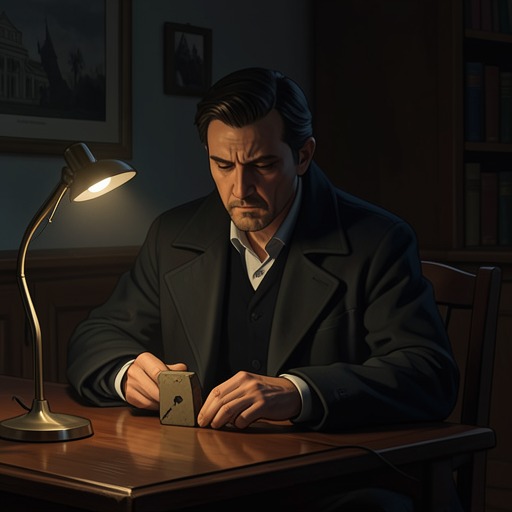
The Brass Verdict
The Brass VerdictThe Brass Verdict is Harry Bosch’s term for a killing that functions as street justice: a private judgment imposed outside the legal process when someone decides not to wait for justice to arrive through a trial. The phrase brings the book’s concern with justice and its counterfeits into the same conversation. It names an act that can resemble a verdict in its claim to settle a case, while remaining a killing rather than a judgment reached through law. By the end, Mickey Haller turns the phrase inward, calling it the last verdict of his own legal career.
Meaning and Use
Bosch explains the expression by recalling his time riding patrol and the name officers used for a killing that came down to street justice. The explanation is direct: the brass verdict is not a courtroom ruling, nor a lawful substitute for one, but a killing given the meaning of a final judgment. The phrase compresses two incompatible ideas into one: a verdict ordinarily belongs to a legal process, while this one is delivered outside it, through violence.
That tension matters because Bosch introduces the term while discussing the fate of Walter Elliot and the course of the trial. He tells Haller that Elliot had momentum and seemed likely to walk; someone, Bosch says, chose not to wait for justice and delivered his own verdict. The phrase therefore describes not a general theory detached from events, but Bosch’s interpretation of a killing in the shadow of a trial whose outcome appeared to be moving toward acquittal. The evidence identifies no individual as the person who delivered this verdict in their exchange, and Bosch’s explanation does not turn the act into a lawful or reliable finding of guilt.
Justice and the Trial
The conversation circles around an earlier exchange in which Haller had told Judge Holder that he knew she was behind what had been happening. Bosch recalls Haller’s belief that sometimes justice cannot wait, then reverses its application. In Bosch’s account, the idea that justice should not be delayed becomes the rationale someone uses to act before the trial can conclude. The principle thus carries a disturbing double edge: impatience with injustice can become a justification for bypassing the very process meant to determine guilt.
The contrast is not between justice and mere delay alone. Haller’s work in the trial had produced momentum for the defense, and Elliot appeared likely to escape conviction. Bosch’s account places the killing against that prospective outcome, making the brass verdict a response to what its unknown deliverer believed the formal proceeding would fail to accomplish. But the phrase cannot establish whether that private judgment was accurate or just. Its certainty is precisely what makes it a counter-verdict: it ends the question by force instead of resolving it through the trial.
Haller’s Last Verdict
After Bosch names the brass verdict, Haller understands what he means, and the two remain silent for a long moment. The pause gives the phrase weight beyond its definition: it joins the case’s apparent endpoint to the unresolved balance between legal justice and private violence. Bosch then leaves to prepare to put people in jail, returning to the institutional work that the term has set against the killing.
The phrase becomes personal when Haller says he is quitting his job and the law, describing the brass verdict as his last verdict. His declaration recasts the expression from a label for a killing into a marker of professional departure. The word verdict had belonged to his work as a lawyer; now he applies it to the end of that work. The statement does not explain why he has decided to quit, and Haller himself says he is unsure why he said it. Its force lies in the abruptness of the announcement and in the way the case’s final violence appears to close, at least for the moment, his participation in the legal world.
An Unsettled Ending
Bosch answers that he once quit too, but came back. Haller’s brief response leaves his own decision open: he does not confirm that he will return, and the conversation supplies no settled future. The exchange therefore gives the phrase two different endings. Bosch’s brass verdict names a killing treated as a final answer to the trial’s uncertain course; Haller’s last verdict names a professional ending whose permanence remains uncertain.
That contrast keeps the concept from collapsing into a simple condemnation or endorsement of Haller’s departure. The phrase carries the force of finality, yet Bosch’s recollection of returning to work makes finality itself provisional. The book leaves the reader with the distinction between a verdict imposed by killing and a verdict Haller passes on his own career: one is Bosch’s description of an extra-legal act, while the other is Haller’s declaration, still shadowed by the possibility that it may not be his last word.